The home of architecture and design in the Asia-Pacific
Get the latest design news direct to your inbox!

Get the latest design news direct to your inbox!
Andrea Mulloni is the head of sustainability at furniture manufacturer, Arper. With a particular emphasis on the evolving Catifa Carta chair, we chatted to him at Arper’s stand during Milan Design Week.

Catifa (RE) 53, photo by Alberto Sinigaglia.

May 1st, 2025
Timothy Alouani-Roby: We covered the Catifa Carta chair last year, so please tell me a bit about the evolution from where you were to where the product is today?
Over the last few years, Arper has been looking at the impact that this furniture is actually generating – both positive and negative. That’s where Catifa Carta came from, so we are actually applying a theory of change to product design and we realised that’s the good way to go.
What I can tell you on top of that is that obviously Arper has got a product development plan which stretches over three or four years generally. But once we saw the results and the feedback that we got on that – in terms of LCA (life-cycle assessment) results and impact in general CO2 emissions – that actually changed the whole [set of] priorities. That’s why, this year, you see a version of Catifa 46, which is the smaller version of Catifa 53. Then there are also other developments, like, for example, trying to take away metal. So, that’s the evolution – we are geared towards the impact we are generating rather than just the product and the aesthetics of it.


I noticed some other features around the base and legs might have been, as well as some innovations remove glue joins?
All of that information is derived from the LCAs that we are doing on our products. What we realised there, obviously, is the impact of glue. Disassembly is another big feature of circular economy in general. So, we wanted to take away that glue and we actually engineered a way of screwing these legs on a very small metal frame. That way, we reduce it to the minimum, because that’s the real impact that is driving all things.
We were able to go from more or less 12 kilograms of emissions in that chair to what we estimate being around 8 kilograms, so it’s a very good improvement. That also drives the innovation development towards what we would like to achieve in the future – the overarching goal is to produce a chair which is going to be carbon negative. We are on our way to going there.
Basically, with the application of this innovation and the material together, together with the business model where we manage the end-of-life of the product, we have been able to cut more or less half of the emissions from the plastic one.
Related: Product highlights from Milan 2025
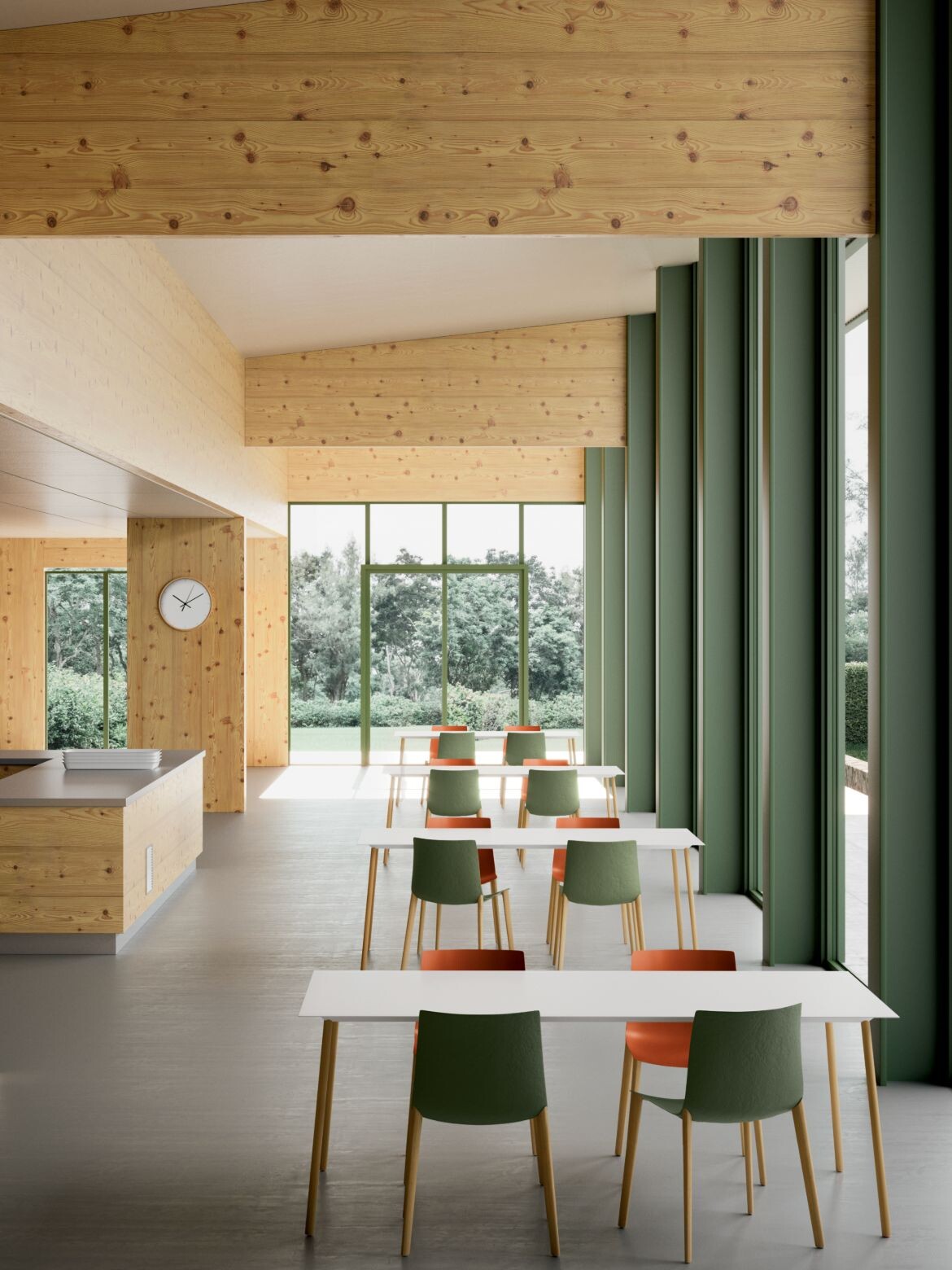
We’ve heard about the specific products and the technical details, but you’re also exploring ‘spaces and solutions for the project of living’ – can you explain the conceptual focus here?
Well, I think it starts from the focus on why you’re doing things. If you’re [making a product] just for aesthetic purposes, then it’s one thing – you’re starting from the company and going out. [When you start by] thinking about spaces and how people live, then you do it the other way around – you’re thinking about what people actually need, what you should do to make them live better, and then you translate this into a product.
If you’re thinking about like what people are actually asking – what they would really like, apart from just furniture to sit on – it’s the recognition that we need to act in terms of climate and environmental solutions. We are trying to transpose these needs into what we do every day, which is furniture.
Arper is available in Australia through Stylecraft


INDESIGN is on instagram
Follow @indesignlive
A searchable and comprehensive guide for specifying leading products and their suppliers
Keep up to date with the latest and greatest from our industry BFF's!
The internet never sleeps! Here's the stuff you might have missed