The home of architecture and design in the Asia-Pacific
Get the latest design news direct to your inbox!

Get the latest design news direct to your inbox!
With a lacework of 2,000 polished stainless steel pieces, Nendo created a subtly shifting backdrop for an ikebana exhibition in Tokyo.
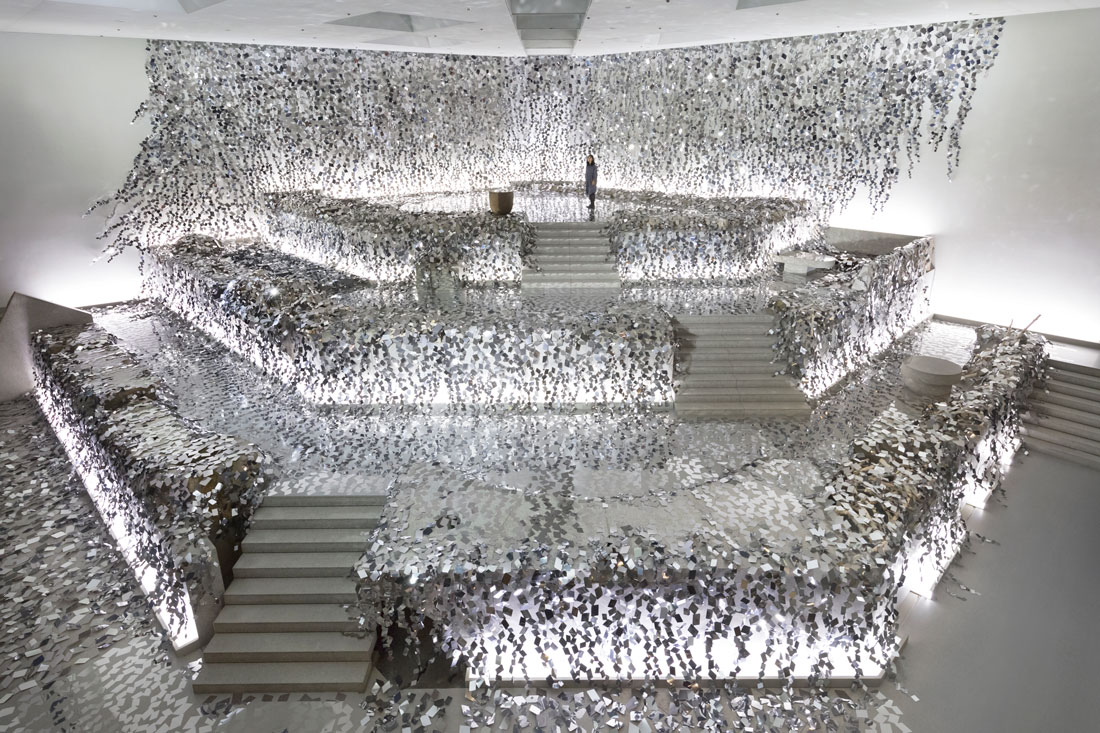
Photo: Takumi Ota
June 1st, 2017
When the Sogetsu School of Ikebana was founded in Tokyo in 1927, the popular conception was that ikebana meant following established forms. Sofu Teshigahara had other ideas. The School’s founder broke away from traditional forms and promoted the idea that ikebana could be created with any material and placed anywhere – even in Western spaces.
His granddaughter Akane Teshigahara is now the third iemoto (head) of the Sogetsu School, and she similarly embraces ‘free creation’. So much so that for the School’s recent 90th anniversary exhibition, she turned the tables on traditional modes of exhibition planning.
Usually, the exhibited works are selected or created in advance, and the exhibition space is designed to accentuate them. Teshigahara worked the other way around, engaging Nendo to create an environment within Sogetsu Plaza – an interior rock garden designed by Isamu Noguchi within the Sogetsu Foundation Headquarters building, which was itself designed by Kenzo Tange. The exhibited ikebana artworks would respond to this environment.
Nendo aimed to make the most of Noguchi’s tiered stone garden by reflecting the stone as well as the exhibited floral artworks. An ‘ivy’ of small pieces of 0.5mm-thick stainless steel sheet, cut into small connected rhombus shapes (linked in long chains), became a curious layer between the stone and the artworks. The intention, says Nendo, was to “create a harmony between them, as if the flowers were gently enfolding the stone garden.”
Glimpses of the surrounding space, glimpses of the stone, and glimpses of the flowers became enmeshed and produced a kaleidoscopic effect.
Photography by Takumi Ota and Kozo Sekiya, courtesy of Nendo.
INDESIGN is on instagram
Follow @indesignlive
A searchable and comprehensive guide for specifying leading products and their suppliers
Keep up to date with the latest and greatest from our industry BFF's!
The internet never sleeps! Here's the stuff you might have missed